
For their fifth consecutive participation at the Venice Biennale, Luxembourg chose the authors of their pavilion through an open competition entitled Futura Bold – a term that illustrates the aim of this small European coutry to position itself through a project that analyzes and discusses the contemporary built environment on a national, european and global scale.
The chosen project is Post-City by Yi-der Chou, Radim Louda and Philippe Nathan. This young team assumed a sensitive approach to analysis of existing forces of Luxembourg’s built environment. They define their project as an attitude towards the city rather than an urban proposal.
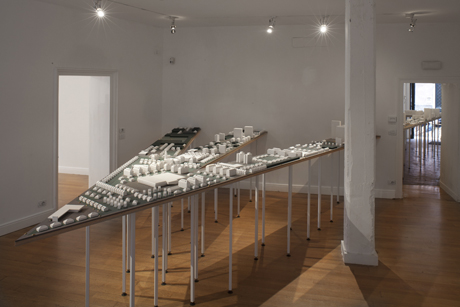
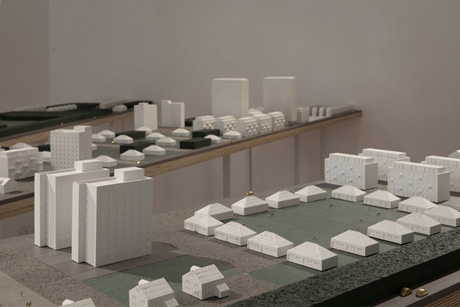
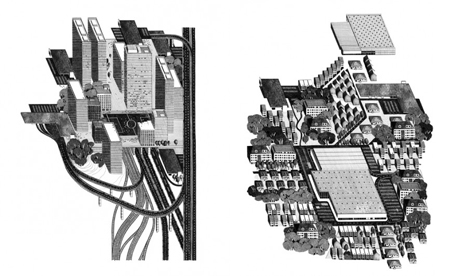
Post—City proposes to link five specific environments of contemporary Luxembourg. Considered by the authors to be equally important, Belval, Berchem, Ingeldorf, Kirchberg and Schengen are connected by a dense corridor of urban scenes. Made of an extremely pragmatic infrastructure and an accumulation of existing and fictional built situations, Post-City acts as a visual concentration of urban realities and potentials. As a natural consequence of the process, a triangular urban fabric with a connected heart cuts through Luxembourg, creating, as a leftover, an undefined landscape, a territory of all possibilities.
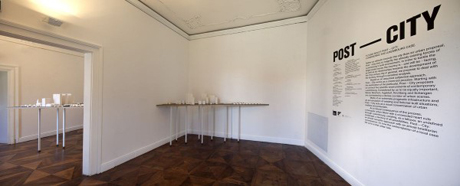
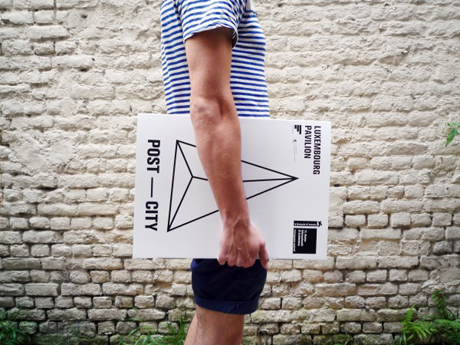
The contribution, which is staged at an apartment at the Ca’ del Duca on the Grand Canal in the city centre, is composed of a plaster model installation which is being produced in collaboration with Vincent de Rijk (Rotterdam), five artworks/illustrations in DIN A0 format drawn by Eva le Roi (Brussels) and a book, for which Manuela Dechamps Otamendi (Brussels) did the layout and graphic design and Maxime Delvaux (Brussels) the photography. The latter does not only serve as a guidebook for the exhibition, but does also and foremost illustrate and open up new questions and discussions, and this through the intervention of writers, critics, researchers and architects.
We talked to Radim Louda, one of the pavilion's authors. This young Belgium architect with an international experience answered several questions regarding the project and the exhibition concepts.
CAB: We've read about the project in the Press release. We especially like the 7 situations and their illustrations. They present interesting futuristic ways of creating synergies of seemingly disparate spaces and programs. How much have you drawn from the actual urban reality of Luxembourg to create these scenarios? Are some of these synergies already present on site?
RL: First of all, Post-City should be consider as an attempt to investigate the potentials of the already present forces of the environment through a sensitive approach. We started by choosing 5 specific places that seemed to us to be representative of a certain reality of the country. With a photographer (Maxime Delvaux/354 photographers) we went to investigate the places 'in-situ'. Some of the tensions or synergies that you can find in the scenarios are actually a blow-up or exageration of the reality. Luxembourg could be considered as a so-called 'In-between city' (confer. Thomas Sieverts), a place that doesn't have either a straight urban or rural condition. This unplanned (r)urban state of the country leads to situations that are too often unconsidered or neglected by architects, for us it was important to explore them and consider them as our primary working material.
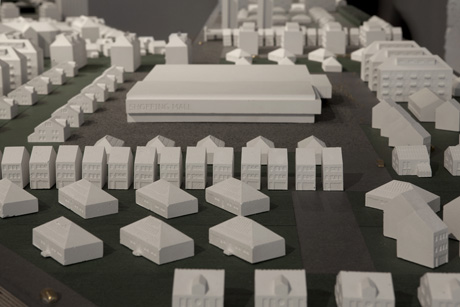
From those 5 existing situations, we have chosen 19 building typologies (the pavilion, the gas station, the office tower...) that compose those built environments. The scenarios are the consequence of a shift of those typologies in order to create new potential (r)urban dynamics.
CAB: Post-City proposes a network of connections between 5 locations in Luxembourg that each have their own specific character and importance for the country's development. If we assume these connections are an infrastructure for future development, what do you think would happen to the left-over space, this 'territory of all possibilities'?
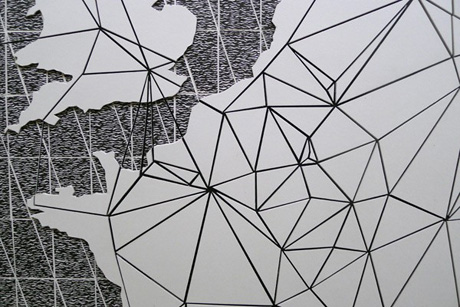
RL: We decided to concentrate our energy in 'an infrastructure for future development' for two reasons. The first one is simply a practical one. If you want to approach the complexity of a territory you have to use simplified means. By concentrating the potentialities and realities of Luxembourg in this strip we were able to accentuate the narrative and to point out specific conditions and most of all the rough and direct connections between them. The second point leads us to the consideration of the leftover space, the 'territory of all possibilities'. As young architects we have learned the failure of big urban gestures and planifications. At the same time we can not imagine to leave the the (r)urban developments without any directions or considerations about their future. In this sense, we wanted to develop a double discourse. The situations that we show in the Post-city strip are coming from specific Luxembourgish conditions but at the same time are totally retransposable in other european countries. The european map with the triangular net drawn by Eva le Roi, tries to show the repetition and the generic condition of such territories in the globalized Europe. The leftover or negative space created acts as a necessary space for everything that wants, should or have to escape from the condition of the contemporary global 'city'. It's upon to you to decide what you want to put in it, we prefer to leave it as it is, 'a territory of all possibilities'.
CAB: The Biennale exhibition contains a physical model, 5 illustrations and a book. Could you explain how each of these are connected to the project and why are they important?
RL: With Post-city we try to 'approach' our contemporary built environment. We try to raise questions more than give answers. In this sense, we found important to surround the complexity of the territory by different means. Even though they are considered as of the same importance they propose different approaches to the territory. The physical condition of the model shows in a direct way the connections between the typologies, a new reality is shown. The illustrations made by Eva le Roi insist on the relations between the different scales, a zoom-out serie shows the approach that we had. We considered the territory as well in its domestic character as in its relationship to the global scale. The book is made in 3 parts, one shows the typologies and the pictures of the exisiting environments, the second one explain the scenarios that we created. For the third part we asked to different contributors to write about Post-city, a compilation of texts from renowned architects as from young ones creates a corpus that shows different points of views and creates in itself its own narration about the subject. Each 'piece' should be considered as well as a 'tool' during the process as the 'final product' of it.
CAB: How much did the site itself - the apartment at the Ca’ del Duca - inform the exhibition content and setup?
RL: The Ca' Del Duca apartment is a very specific site. Situated in front of the Grande Canale, the apartment has a real historical and at the same time domestic feeling. Introducing an installation that talks about the country scale in an apartment created really unexpected but powerfull relations. The model 'cuts through' five rooms. Each of the 5 existing situations has its own room, its own specific condition. The impact of the context on a installation that tries to show the potential of the generic and existing conditions appeared to us as really exciting.
CAB: Did u get any feedback from the visitors of the Biennale? What was their reaction to the exhibition and the Post-City project?
RL: The aim of Post-city was to raise questions on different levels to different people. The Biennale has the chance to get the visitor 'lambda' as well as specialized people from the field. For now on we had a really good feedback from both. The installation works on different levels. We've seen people getting really excited by the 'beauty' or 'sharpness' of the model, the illustrations and the book and then, by taking time, getting really in to the depth and start to debate. I have to say that we are pretty glad with people reactions. We got proposals to exhibit the project in other cities in Europe, which actually is interesting in the sense that we consider Post-city not only as a specific project for Luxembourg but also as a broader reflexion about the contemporary city conditions.
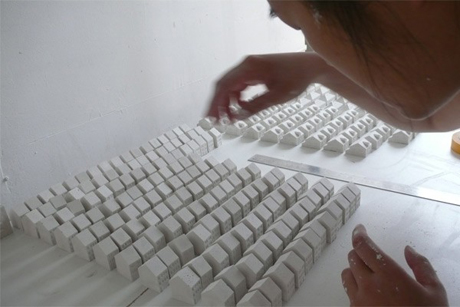
Photo: 354photographers, Philippe Nathan, Manuela Dechamps Otamendi
Illustrations: Eva le Roi
© Fondation de l' Architecture et de l Ingenierie, Luxembourg 2012 www.fondarch.lu


 Ljubljana-based architectural studio
 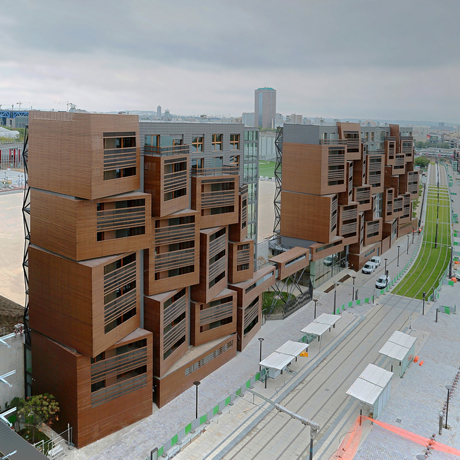 The parcel has a very particular configuration; 11m in width and extending approximately 200m north-south. This foreshadows the importance of processing the eastern facade overlooking the extension of the street Des Petits Ponts which hosts the tram and both cyclist and pedestrian walkways.
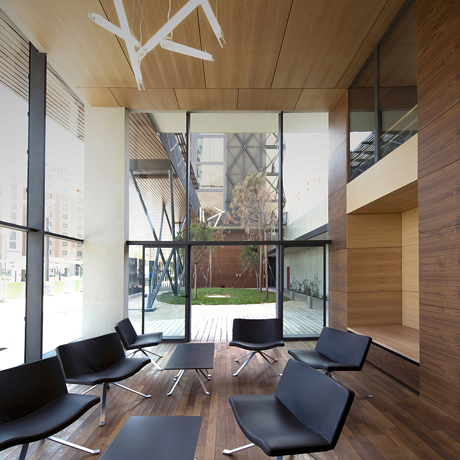
The long volume of the building is divided into two parts connected with a narrow bridge. Between two volumes there is a garden. The building has 11 floors: a technical space in the basement, shared programs in the ground floor, and student apartments in the upper nine floors. The layout is very rational and modular.
The parcel has a very particular configuration; 11m in width and extending approximately 200m north-south. This foreshadows the importance of processing the eastern facade overlooking the extension of the street Des Petits Ponts which hosts the tram and both cyclist and pedestrian walkways.
The long volume of the building is divided into two parts connected with a narrow bridge. Between two volumes there is a garden. The building has 11 floors: a technical space in the basement, shared programs in the ground floor, and student apartments in the upper nine floors. The layout is very rational and modular.
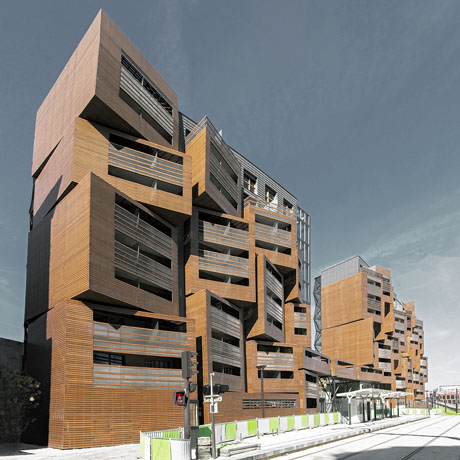 The major objective of the project was to provide students with a healthy environment for studying, learning and meeting. The ground floor houses common spaces, dining area and living space. Along the length of the football field is an open corridor and gallery that overlooks the field and creates a view to the city and the Eiffel tower. This gallery is an access to the apartments providing students with a common place. The dormitory has 192 studios, all of the same size and containing the same elements to optimize design and construction: an entrance, bathroom, wardrobe, kitchenette, working space and a bed. Each apartment has a balcony overlooking the street.
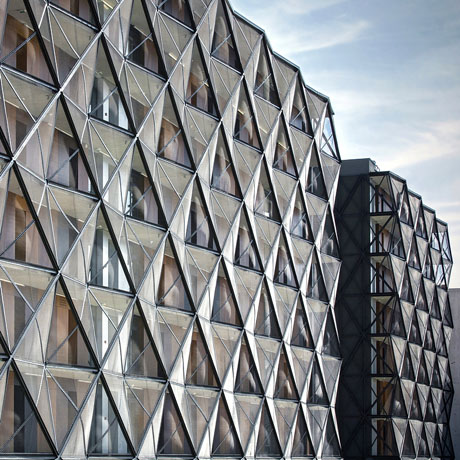 Narrow length of the plot with 10 floors gives to site a significant presence. Each volume contains two different faces according to the function and program:
The elevation towards the street des Petits Ponts contains studio balconies-baskets of different sizes made from HPL timber stripes. They are randomly oriented to diversify the views and rhythm of the façade. Shifted baskets create a dynamic surface while also breaking down the scale and proportion of the building.
The elevation towards the football field has an open passage walkway with studio entrances enclosed with a 3D metal mesh. Both volumes are connected on the first floor with a narrow bridge which is also an open common space for students.
Narrow length of the plot with 10 floors gives to site a significant presence. Each volume contains two different faces according to the function and program:
The elevation towards the street des Petits Ponts contains studio balconies-baskets of different sizes made from HPL timber stripes. They are randomly oriented to diversify the views and rhythm of the façade. Shifted baskets create a dynamic surface while also breaking down the scale and proportion of the building.
The elevation towards the football field has an open passage walkway with studio entrances enclosed with a 3D metal mesh. Both volumes are connected on the first floor with a narrow bridge which is also an open common space for students.
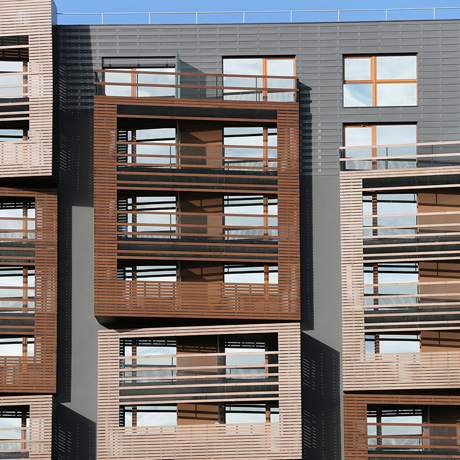 The building is energy efficient to accommodate the desires of Paris' sustainable development efforts. The Plan Climates goal is that future housing will consume 50KW-h.m.² or less. The objectives of energy performance and the construction timetable were met by focusing on a simple, well insulated and ventilated object that functions at its best year round. Accommodations are cross ventilating and allow abundant day lighting throughout the apartment. External corridors and glass staircases also promote natural lighting in the common circulation, affording energy while also creating comfortable and well lit social spaces.
 The building is insulated from the outside with an insulation thickness of 20 cm. Thermal bridge breakers are used on corridor floors and balconies to avoid thermal bridges. Ventilation is controlled by double flow mechanical ventilation, providing clean air in every apartment with an optimum temperature throughout the year. The roof is covered with 300m² of photovoltaic panels to generate electricity. Rainwater is harvested on site in a basin pool used for watering outdoor green spaces.
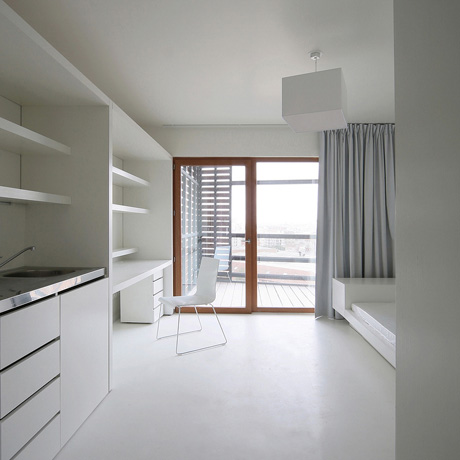 Photo: © Tomaz Gregoric
  Singapore's Gardens by the Bay has won the top prize, World Building of the Year, at the World Architecture Festival that was also held in Singapore this year.
Officially the prize went to Wilkinson Eyre Architects from London, but jury represented by such names as: Ben Van Berkel, Moshe Safdie, Jϋrgen Mayer H, Yvonne Farrell, insisted that the whole design team should have recognition (Grant Associates, Atelier One i Atelier Ten) for this magnificent team effort.
Singapore's Gardens by the Bay has won the top prize, World Building of the Year, at the World Architecture Festival that was also held in Singapore this year.
Officially the prize went to Wilkinson Eyre Architects from London, but jury represented by such names as: Ben Van Berkel, Moshe Safdie, Jϋrgen Mayer H, Yvonne Farrell, insisted that the whole design team should have recognition (Grant Associates, Atelier One i Atelier Ten) for this magnificent team effort.
 Located in Marina Bay, Gardens by the Bay is a key project in delivering the Singapore Government’s vision of transforming Singapore into a ‘City in a Garden’. At a total of 101 hectares, the Gardens by the Bay project comprises three distinct waterfront gardens.
At the heart of Bay South Garden is the Cooled Conservatory Complex which is the focal point of the Gardens. The two main Conservatories cover an area in excess of 20,000sq m and are among the largest climate-controlled glasshouses in the world. They provide a spectacular, all-weather attraction and comprise a cool dry conservatory (the ‘Flower Dome’) and a cool moist conservatory (the ‘Cloud Forest’). Each has its own distinct character, but both explore the horticulture of those environments most likely to be affected by climate change.
Located in Marina Bay, Gardens by the Bay is a key project in delivering the Singapore Government’s vision of transforming Singapore into a ‘City in a Garden’. At a total of 101 hectares, the Gardens by the Bay project comprises three distinct waterfront gardens.
At the heart of Bay South Garden is the Cooled Conservatory Complex which is the focal point of the Gardens. The two main Conservatories cover an area in excess of 20,000sq m and are among the largest climate-controlled glasshouses in the world. They provide a spectacular, all-weather attraction and comprise a cool dry conservatory (the ‘Flower Dome’) and a cool moist conservatory (the ‘Cloud Forest’). Each has its own distinct character, but both explore the horticulture of those environments most likely to be affected by climate change.
 The Flower Dome tells the story of plants and people in the Mediterranean climate zone, aims to bring alive the experience of seasonal change for visitors more used to Singapore’s eternally tropical climate and lush green vegetation. Even the landform of the conservatories draws inspiration from Mediterranean landscapes and evokes the language of dry, sun-baked hillsides punctuated with rocky terraces and stony outcrops, and the intimate bond between land, geology, vegetation and cultivation.
The Cloud Forest highlights the relationship between plants and the planet, showing how the warming of the cool tropical cloud forests will threaten biodiversity. With a smaller footprint but greater height than Flower Dome, it has at its heart a planted ‘Mountain’ from which a 35m high waterfall drops. Visitors can experience the forest at different levels, but most interesting is a Cloud Walk between tree crowns.
The Flower Dome tells the story of plants and people in the Mediterranean climate zone, aims to bring alive the experience of seasonal change for visitors more used to Singapore’s eternally tropical climate and lush green vegetation. Even the landform of the conservatories draws inspiration from Mediterranean landscapes and evokes the language of dry, sun-baked hillsides punctuated with rocky terraces and stony outcrops, and the intimate bond between land, geology, vegetation and cultivation.
The Cloud Forest highlights the relationship between plants and the planet, showing how the warming of the cool tropical cloud forests will threaten biodiversity. With a smaller footprint but greater height than Flower Dome, it has at its heart a planted ‘Mountain’ from which a 35m high waterfall drops. Visitors can experience the forest at different levels, but most interesting is a Cloud Walk between tree crowns.
 Gardens by the Bay are open for visitors from June 2012 and during August 1.000.000th visitor is registered.
Photo: © Gardens by the Bay
Gardens by the Bay are open for visitors from June 2012 and during August 1.000.000th visitor is registered.
Photo: © Gardens by the Bay  Yet another manifestation worthy of our attention, held as part of Vienna Design Week, gave us the extraordinary overall impression and caused an unusual feeling within its audience. The exhibition that says – come, see, feel, touch – is an original presentation of sea elements shaped in a specific and poetic way. Simply said – this is an unusual display guided by indefatigable strength of imagination.
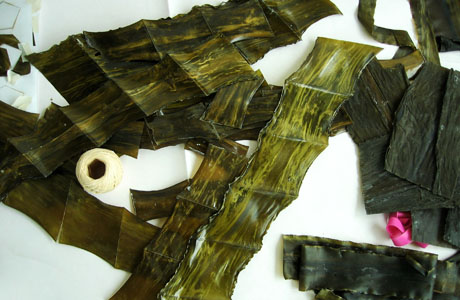 This exhibition presented within vast glass walls of Kunsthalle (literally “Space for art”) is a work and vision of multidisciplinary designer Julia Lohmann. Julia Lohmann is a professor at the University of Fine Arts in Hamburg where she restlessly develops a completely new world of magic intended for all. At the same time she is a researcher at the Department of Design Products at the Royal College of Art in London. Her research is currently focused on development of materials and shapes made from kelp.
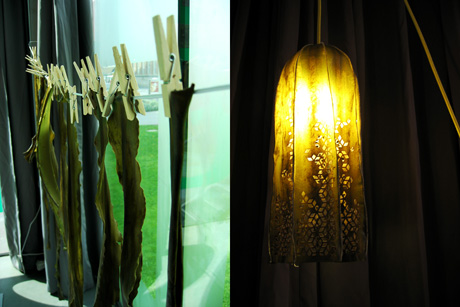 This successful designer of bold ideas constantly explores contemporary issues such as the relationship of man and nature, with an accent on animal world, that guides her work towards exploring her own personality. Constant dilemmas within a human being are turned into an artistic expression and are meant for questioning our own emotions. Sometimes meant to appall, her design is above all surreal. And the exhibition itself presents a mystical scene that will take us away from the real world by moving us into the deep blue sea.
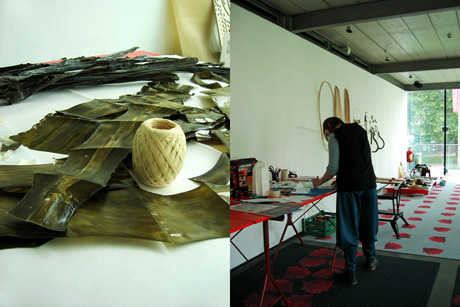 The displayed moment of inspiration, that possesses a certain specific strength, is a reinterpretation of her “giving value to leftovers“ motto. Sea weeds are placed by one another in a form of a cover onto the bearing structure made from metal, fiberglass or wood. The process of forming unusual structures by connecting those carefully prepared “sea strings“ might seem as the product of a pure coincidence. But in reality, with a careful study of the very nature of used material, Julia Lohmann has learned how to “listen“ and feel the movement and the behavior of nature thus guiding her work in desired direction. In every moment she possesses the control over the form that gives her unlimited possibilities of form-making. Every design becomes a possibility that erases the line between the reality and imagination. Her sculptures become silent story-tellers of hidden secrets written within the great waves of the sea, making some ordinary things come to life – from luminaires to everyday hats. In the variety of design expressions Julia Lohmann also generated a unique-looking fabric made of kelp that resembles the soft nature of leather by its texture and structure.
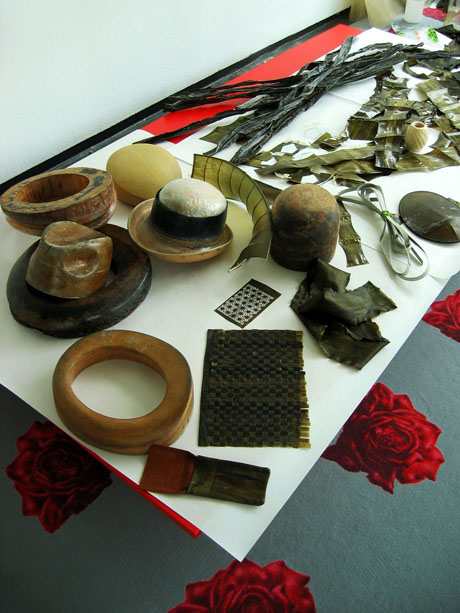 This revolutionary employment of unusual natural material presents one step further in a constant battle over usage of environment-threatening products. Making us think “green“, Julia Lohmann started her own battle for the well being of our planet.
For more information about Julia Lohmann please visit
This revolutionary employment of unusual natural material presents one step further in a constant battle over usage of environment-threatening products. Making us think “green“, Julia Lohmann started her own battle for the well being of our planet.
For more information about Julia Lohmann please visit  The Vienna design week is being held from September 28th to October 7th, for the fifth consecutive year. Yet another exquisite and colourful programme of events awaits the visitors this fall, with the aim to show and enable people to experience the many-faceted creative work in the fields of product, furniture and industrial design as well as experimental design. Design has been and is an important field in the production of culture: it shapes our material culture, our everyday life and our consumer world, it influences our lifestyles and fashions and most fundamentally our aesthetic sense and judgements.
The festival’s events are scattered all over the city and organized in cooperation with many partners – from Vienna museums to production and retail companies to designers from all over the world. A large number of shops takes part in the festival by offering their customers special deals on designer furniture and products.
The Vienna design week is being held from September 28th to October 7th, for the fifth consecutive year. Yet another exquisite and colourful programme of events awaits the visitors this fall, with the aim to show and enable people to experience the many-faceted creative work in the fields of product, furniture and industrial design as well as experimental design. Design has been and is an important field in the production of culture: it shapes our material culture, our everyday life and our consumer world, it influences our lifestyles and fashions and most fundamentally our aesthetic sense and judgements.
The festival’s events are scattered all over the city and organized in cooperation with many partners – from Vienna museums to production and retail companies to designers from all over the world. A large number of shops takes part in the festival by offering their customers special deals on designer furniture and products.
 The festival aims to reveal creative and production processes and encourage experimental work on the spot. It also presents and promotes design that in the first instance withdraws from the scheme of utility value and functionality in order to create awareness and pose questions or also simply just to have fun.
With exhibitions, venue-specific installations, workshops, lectures, discussion events, a programme of films and, of course, enough opportunity to party and network, Vienna design week is not only an attraction for the international design scene but most explicitly also aims to interest and appeal to a wide public audience of Viennese and visitors to Vienna.
The festival aims to reveal creative and production processes and encourage experimental work on the spot. It also presents and promotes design that in the first instance withdraws from the scheme of utility value and functionality in order to create awareness and pose questions or also simply just to have fun.
With exhibitions, venue-specific installations, workshops, lectures, discussion events, a programme of films and, of course, enough opportunity to party and network, Vienna design week is not only an attraction for the international design scene but most explicitly also aims to interest and appeal to a wide public audience of Viennese and visitors to Vienna.
 One of the main venues of the festival is Jean Nouvel’s Stilwerk building. The events in this space are connected through the common topic od recycling and reusing old and discarded objects to create new products. This weekend Stilwerk was home to the Misfits Revisited workshop, headed by the Viennese design group breadedEscalope. Earlier this year breadedEscalope began an experiment investigating the products, employees and brand of the long established company of Thonet. The cooperation does not work on the basis of a briefing but on the freedom of communicating an analysis of the form, material, tradition and processes involved in inventing a product. The visitors could, within the framework of the workshop, create or re-create their own “Thonet” out of discarded pieces from the Thonet factory, and take their creation home.
 Zurich designers
  Grafton Architects from Dublin, Ireland, received the Silver Lion award at this year’s Venice architecture Biennale, for their impressive presentation of the project for a university campus in Lima, Peru. The Silver Lion is awarded to emerging architects who raise expectations, and it is the first time a practice from Ireland won this prestigious award.
Presenting their architecture as a “new geography”, the Dublin-based office uses this exhibition to explore characteristic historical examples of architecture merging with the landscape, as well as the work of Brazilian architect Paolo Mendes da Rocha, in order to better approach their first project in South America – a university campus in Lima, Peru.
The director of this year’s Biennale, David Chipperfield, who chose the topic “Common Ground”, placed the Grafton Architects exhibition as central in the main Giardini pavilion. The jury president, Dutch architect Wiel Arets, said that this exhibition showcases on various levels the conceptual and spatial qualities and potentials of the way Grafton Architects explore and present the urban landscape.
Grafton Architects from Dublin, Ireland, received the Silver Lion award at this year’s Venice architecture Biennale, for their impressive presentation of the project for a university campus in Lima, Peru. The Silver Lion is awarded to emerging architects who raise expectations, and it is the first time a practice from Ireland won this prestigious award.
Presenting their architecture as a “new geography”, the Dublin-based office uses this exhibition to explore characteristic historical examples of architecture merging with the landscape, as well as the work of Brazilian architect Paolo Mendes da Rocha, in order to better approach their first project in South America – a university campus in Lima, Peru.
The director of this year’s Biennale, David Chipperfield, who chose the topic “Common Ground”, placed the Grafton Architects exhibition as central in the main Giardini pavilion. The jury president, Dutch architect Wiel Arets, said that this exhibition showcases on various levels the conceptual and spatial qualities and potentials of the way Grafton Architects explore and present the urban landscape.
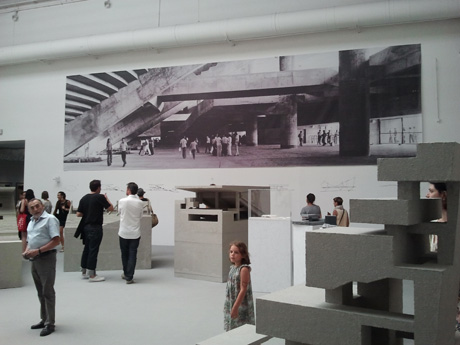 In one part of the exhibition Shelley McNamara and Yvonne Farrell, founders of Grafton Architects, explore the surprising similarities between the Skellig Michael convent in Ireland and the Peruvian city of Machu Picchu. Despite the fact that these two places are separated by a huge physical distance and were created in disparate times, there is a common line that connects them. In both examples the intimate man-made spaces are in perfect harmony with their impressive natural surrounding and, as expressed by the exhibition authors, they tell the same tale.
The exhibition topic is transfered from the past into the present day, and the comparison of distant (yet very near) worlds is repeated in the second part, through the dialogue McNamara and Farrell started with the Brazilian architect Paulo Mendes da Rocha for the purpose of this Biennale.
Grafton Architects recently won a competition for a university campus in Lima, Peru, when they realized that the analysis of da Rocha’s works will improve their knowledge of building tradition and the cultural context of the local site and climate. The analysis features the Serra Duorada stadium designed by the Pritzker Award winner da Rocha in 1973. Using da Rocha’s idea of architecture as a “new geography” and the idea of the university as a “knowledge arena”, Grafton Architects manage to transform infrastructure into an urban landscape. By not treating the architecture as an isolated building, they show a new quality of the inevitable transformations of urban landscape – its complete remodeling.
Probably the biggest importance of this exhibition is the fact that it unequivocally demonstrates how openness to influences is the beginning and pre-requisite to quality architecture. In this sense, Grafton Architects present an excellent answer to the Biennale topic “Common Ground”.
Photo: Miloš Mirosavić
In one part of the exhibition Shelley McNamara and Yvonne Farrell, founders of Grafton Architects, explore the surprising similarities between the Skellig Michael convent in Ireland and the Peruvian city of Machu Picchu. Despite the fact that these two places are separated by a huge physical distance and were created in disparate times, there is a common line that connects them. In both examples the intimate man-made spaces are in perfect harmony with their impressive natural surrounding and, as expressed by the exhibition authors, they tell the same tale.
The exhibition topic is transfered from the past into the present day, and the comparison of distant (yet very near) worlds is repeated in the second part, through the dialogue McNamara and Farrell started with the Brazilian architect Paulo Mendes da Rocha for the purpose of this Biennale.
Grafton Architects recently won a competition for a university campus in Lima, Peru, when they realized that the analysis of da Rocha’s works will improve their knowledge of building tradition and the cultural context of the local site and climate. The analysis features the Serra Duorada stadium designed by the Pritzker Award winner da Rocha in 1973. Using da Rocha’s idea of architecture as a “new geography” and the idea of the university as a “knowledge arena”, Grafton Architects manage to transform infrastructure into an urban landscape. By not treating the architecture as an isolated building, they show a new quality of the inevitable transformations of urban landscape – its complete remodeling.
Probably the biggest importance of this exhibition is the fact that it unequivocally demonstrates how openness to influences is the beginning and pre-requisite to quality architecture. In this sense, Grafton Architects present an excellent answer to the Biennale topic “Common Ground”.
Photo: Miloš Mirosavić  This book represents the first comprehensive framing and treatment of the most important new development in Danish architecture of the 2000s. In the first years after 2000, a young generation of architects hit Danish architecture with renewed energy.
“The New Wave in Danish Architecture” explores the turn through interviews with architects and key stakeholders, essays and presentations of the architects and their works. The book explores how these young Danish architectural offices gained a foothold on the Danish and the international architectural scene in the 2000s with Danish office PLOT/BIG as first mover.
This book represents the first comprehensive framing and treatment of the most important new development in Danish architecture of the 2000s. In the first years after 2000, a young generation of architects hit Danish architecture with renewed energy.
“The New Wave in Danish Architecture” explores the turn through interviews with architects and key stakeholders, essays and presentations of the architects and their works. The book explores how these young Danish architectural offices gained a foothold on the Danish and the international architectural scene in the 2000s with Danish office PLOT/BIG as first mover.
 Among the 12 architectural firms portrayed and featured in the book are PLOT, BIG, JDS, COBE, Transform, Nord, EFFEKT, Adept and others. Comprehensive interviews with Bjarke Ingels (BIG), Winy Maas (MVRDV), Shohei Shigematsu (OMA), Julien De Smedt (JDS), Dan Stubbergaard (COBE) and many more.
The projects of the young Danish offices share certain key commonalities: a new pragmatism, a new willingness to engage in dialog with the world, and a new freshness and straightforwardness in their general approach and rhetoric. A new turn that has become a wave.
This new wave in Danish architecture has been applauded for addressing the time we live in – with globalization, scarce resources, climate issues, the IT revolution, a new media context and, most recently, an economic crisis. But it has also been accused of ignoring certain ideas in the Danish architectural tradition. The book addresses this debate and aims to spark a broader discussion about the future of Danish architecture.
“The new wave in Danish architecture” is not aimed exclusively at architects but at anyone with an interest in architecture. It is based on articles in the magazine Arkitektur DK, Nos. 1 and 2/2012, in an expanded and re-designed form.
The book is published by The Danish Architectural Press in both English and Danish.
To order please use this link
Among the 12 architectural firms portrayed and featured in the book are PLOT, BIG, JDS, COBE, Transform, Nord, EFFEKT, Adept and others. Comprehensive interviews with Bjarke Ingels (BIG), Winy Maas (MVRDV), Shohei Shigematsu (OMA), Julien De Smedt (JDS), Dan Stubbergaard (COBE) and many more.
The projects of the young Danish offices share certain key commonalities: a new pragmatism, a new willingness to engage in dialog with the world, and a new freshness and straightforwardness in their general approach and rhetoric. A new turn that has become a wave.
This new wave in Danish architecture has been applauded for addressing the time we live in – with globalization, scarce resources, climate issues, the IT revolution, a new media context and, most recently, an economic crisis. But it has also been accused of ignoring certain ideas in the Danish architectural tradition. The book addresses this debate and aims to spark a broader discussion about the future of Danish architecture.
“The new wave in Danish architecture” is not aimed exclusively at architects but at anyone with an interest in architecture. It is based on articles in the magazine Arkitektur DK, Nos. 1 and 2/2012, in an expanded and re-designed form.
The book is published by The Danish Architectural Press in both English and Danish.
To order please use this link 


FACEBOOK
LINKEDIN
NEWSLETTER
CONTACT