Luxembourg pavilion – Venice 2012

For their fifth consecutive participation at the Venice Biennale, Luxembourg chose the authors of their pavilion through an open competition entitled Futura Bold – a term that illustrates the aim of this small European coutry to position itself through a project that analyzes and discusses the contemporary built environment on a national, european and global scale.
The chosen project is Post-City by Yi-der Chou, Radim Louda and Philippe Nathan. This young team assumed a sensitive approach to analysis of existing forces of Luxembourg’s built environment. They define their project as an attitude towards the city rather than an urban proposal.
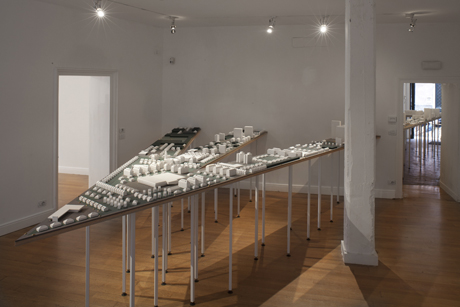
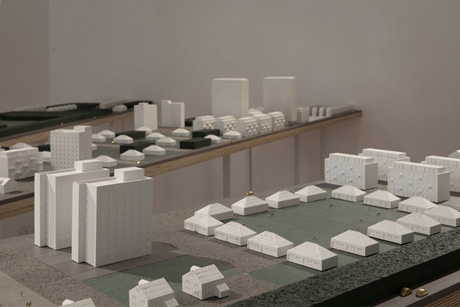
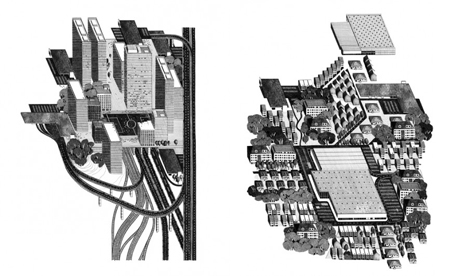
Post—City proposes to link five specific environments of contemporary Luxembourg. Considered by the authors to be equally important, Belval, Berchem, Ingeldorf, Kirchberg and Schengen are connected by a dense corridor of urban scenes. Made of an extremely pragmatic infrastructure and an accumulation of existing and fictional built situations, Post-City acts as a visual concentration of urban realities and potentials. As a natural consequence of the process, a triangular urban fabric with a connected heart cuts through Luxembourg, creating, as a leftover, an undefined landscape, a territory of all possibilities.
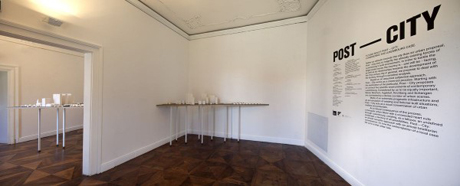
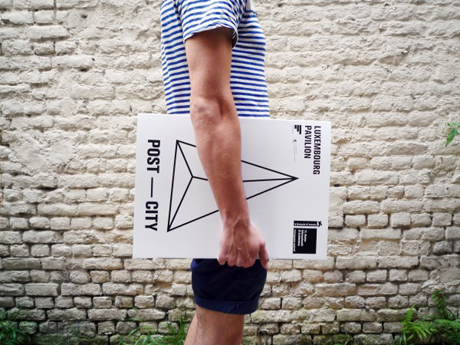
The contribution, which is staged at an apartment at the Ca’ del Duca on the Grand Canal in the city centre, is composed of a plaster model installation which is being produced in collaboration with Vincent de Rijk (Rotterdam), five artworks/illustrations in DIN A0 format drawn by Eva le Roi (Brussels) and a book, for which Manuela Dechamps Otamendi (Brussels) did the layout and graphic design and Maxime Delvaux (Brussels) the photography. The latter does not only serve as a guidebook for the exhibition, but does also and foremost illustrate and open up new questions and discussions, and this through the intervention of writers, critics, researchers and architects.
We talked to Radim Louda, one of the pavilion’s authors. This young Belgium architect with an international experience answered several questions regarding the project and the exhibition concepts.
CAB: We’ve read about the project in the Press release. We especially like the 7 situations and their illustrations. They present interesting futuristic ways of creating synergies of seemingly disparate spaces and programs. How much have you drawn from the actual urban reality of Luxembourg to create these scenarios? Are some of these synergies already present on site?
RL: First of all, Post-City should be consider as an attempt to investigate the potentials of the already present forces of the environment through a sensitive approach. We started by choosing 5 specific places that seemed to us to be representative of a certain reality of the country. With a photographer (Maxime Delvaux/354 photographers) we went to investigate the places ‘in-situ’. Some of the tensions or synergies that you can find in the scenarios are actually a blow-up or exageration of the reality. Luxembourg could be considered as a so-called ‘In-between city’ (confer. Thomas Sieverts), a place that doesn’t have either a straight urban or rural condition. This unplanned (r)urban state of the country leads to situations that are too often unconsidered or neglected by architects, for us it was important to explore them and consider them as our primary working material.
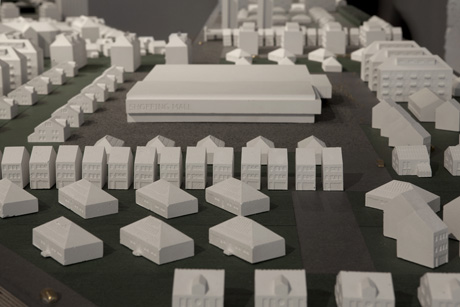
From those 5 existing situations, we have chosen 19 building typologies (the pavilion, the gas station, the office tower…) that compose those built environments. The scenarios are the consequence of a shift of those typologies in order to create new potential (r)urban dynamics.
CAB: Post-City proposes a network of connections between 5 locations in Luxembourg that each have their own specific character and importance for the country’s development. If we assume these connections are an infrastructure for future development, what do you think would happen to the left-over space, this ‘territory of all possibilities’?
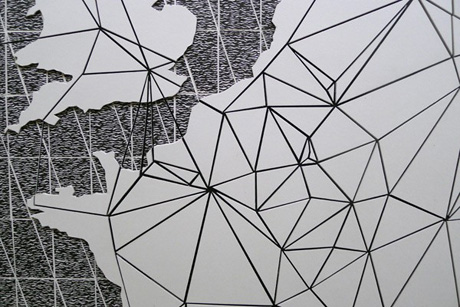
RL: We decided to concentrate our energy in ‘an infrastructure for future development’ for two reasons. The first one is simply a practical one. If you want to approach the complexity of a territory you have to use simplified means. By concentrating the potentialities and realities of Luxembourg in this strip we were able to accentuate the narrative and to point out specific conditions and most of all the rough and direct connections between them. The second point leads us to the consideration of the leftover space, the ‘territory of all possibilities’. As young architects we have learned the failure of big urban gestures and planifications. At the same time we can not imagine to leave the the (r)urban developments without any directions or considerations about their future. In this sense, we wanted to develop a double discourse. The situations that we show in the Post-city strip are coming from specific Luxembourgish conditions but at the same time are totally retransposable in other european countries. The european map with the triangular net drawn by Eva le Roi, tries to show the repetition and the generic condition of such territories in the globalized Europe. The leftover or negative space created acts as a necessary space for everything that wants, should or have to escape from the condition of the contemporary global ‘city’. It’s upon to you to decide what you want to put in it, we prefer to leave it as it is, ‘a territory of all possibilities’.
CAB: The Biennale exhibition contains a physical model, 5 illustrations and a book. Could you explain how each of these are connected to the project and why are they important?
RL: With Post-city we try to ‘approach’ our contemporary built environment. We try to raise questions more than give answers. In this sense, we found important to surround the complexity of the territory by different means. Even though they are considered as of the same importance they propose different approaches to the territory. The physical condition of the model shows in a direct way the connections between the typologies, a new reality is shown. The illustrations made by Eva le Roi insist on the relations between the different scales, a zoom-out serie shows the approach that we had. We considered the territory as well in its domestic character as in its relationship to the global scale. The book is made in 3 parts, one shows the typologies and the pictures of the exisiting environments, the second one explain the scenarios that we created. For the third part we asked to different contributors to write about Post-city, a compilation of texts from renowned architects as from young ones creates a corpus that shows different points of views and creates in itself its own narration about the subject. Each ‘piece’ should be considered as well as a ‘tool’ during the process as the ‘final product’ of it.
CAB: How much did the site itself – the apartment at the Ca’ del Duca – inform the exhibition content and setup?
RL: The Ca’ Del Duca apartment is a very specific site. Situated in front of the Grande Canale, the apartment has a real historical and at the same time domestic feeling. Introducing an installation that talks about the country scale in an apartment created really unexpected but powerfull relations. The model ‘cuts through’ five rooms. Each of the 5 existing situations has its own room, its own specific condition. The impact of the context on a installation that tries to show the potential of the generic and existing conditions appeared to us as really exciting.
CAB: Did u get any feedback from the visitors of the Biennale? What was their reaction to the exhibition and the Post-City project?
RL: The aim of Post-city was to raise questions on different levels to different people. The Biennale has the chance to get the visitor ‘lambda’ as well as specialized people from the field. For now on we had a really good feedback from both. The installation works on different levels. We’ve seen people getting really excited by the ‘beauty’ or ‘sharpness’ of the model, the illustrations and the book and then, by taking time, getting really in to the depth and start to debate. I have to say that we are pretty glad with people reactions. We got proposals to exhibit the project in other cities in Europe, which actually is interesting in the sense that we consider Post-city not only as a specific project for Luxembourg but also as a broader reflexion about the contemporary city conditions.
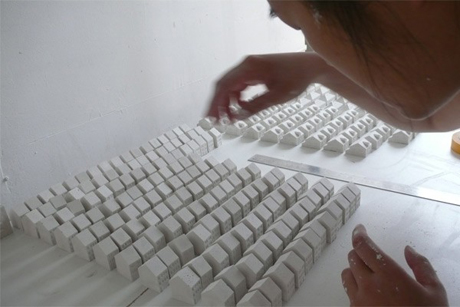
Photo: 354photographers, Philippe Nathan, Manuela Dechamps Otamendi
Illustrations: Eva le Roi
© Fondation de l’ Architecture et de l Ingenierie, Luxembourg 2012 www.fondarch.lu
FACEBOOK
LINKEDIN
NEWSLETTER
CONTACT