
Branka Prpa et al., eds., To Live in Belgrade 1-6: Documents of Belgrade City Administration (Belgrade: Historical Archives of Belgrade, 2003-2008).
The heading of this text might have been just as well How I read the 3,000 pages that weren’t written to be read at all or Manual for urbanization of small oriental towns or The things they did not teach us in history classes or... let’s try that way:

How I read the 3,000 pages that weren’t written to be read at all
Unlike other publications presented here previously, this one happened by chance – or at least unplanned. Somebody telephoned me and said that the Historical Archives of Belgrade posted an information on their Facebook page, that said something like: “We hereby invite this gentleman to contact us, for he will, as the one-thousandth liker of our page, receive a gift.” Maybe it did not say liker, but something more decent; never mind. In communication with the kind officials of the Historical Archives, I have learned that they actually do wish to give me one of the books they published. From the list of available publications, I have recognized and selected, rather nasty, the books that I am writing about now. Books, since – unlike other offered items, this was a set of six hard-cover thick books. Still, until I picked up two full bags from the porter, I did not quite believe they would give me all six of them.
So I became the lucky winner. And I actually won selected documents from the archives of Belgrade City Administration, from the period 1837 to 1940. This collection of documents represents a radical example of the popular approach to history not as a listing of dates of great battles, but as the history of everyday life. Recently, several outstanding researches dealing with everyday life in Belgrade have been published – to mention only the books Cobblestone and Asphalt by Dubravka Stojanović [1] and Bazaars and Boulevards by Nataša Mišković [2] – but the stuff that I got was something else – the original material.

Documents were edited and prepared in a brutally modest way, just like contemporary bureaucrats mass-produce them today using MS Word. But it is exactly their rough appearance, with archive numbers and formal sections without real meaning, that makes these books romantic. One can imagine big-moustached clerks writing these documents – beginning with ornamented handwriting, that turns by the end into an illegible line bending between spilled ink dots. The contents of these documents, just like their appearance, varies from precise lists and grotesque apologetic pleads to higher instances, to quickly or lazily scribbled reports on how there was nothing to report. Scribes, policemen, pleaders, strict administrators, engineers- dreamers and worried doctors managed to fill the rigid form of the official correspondence with all the liveliness of Belgrade as it was then, its problems, smells, changes.
I have read the complete contents of all six volumes from beginning to the end without skipping pages (like a madman reads the phone book, as Bogdan Tirnanić would say). I went through the pages hastily, with a suspicious-looking smile, like a high-school boy looking at porn – enchanted with the stuff he sees and impatient to learn something even more interesting on next pages.

Manual for urbanization of small oriental towns
Among the documents included in this selection, besides notes on happy or morbid trivial situations, there is a substantial amount of data on people and events that essentially influenced the development of Belgrade and the transformation of its parts, streets and the way of life into something we can recognize. Those are the most valuable and for us the most interesting parts.
Changes can be tracked on multiple levels through time – from language changes, with gradual replacement of Turkish words with new ones, that we know or at least understand, to notes on actual realizations of these new ideas, represented by new words (tramway, public lighting, pavement, photography and telegraph slowly take the place of once so important terms, like seymen, gümrük or haraç).

One can learn a lot from these texts about the ways of dealing with various problems that the citizens and city administration faced during the construction and maintenance of infrastructure systems, tracing and paving of streets, reconstruction of whole quarters, establishing communal order. While we find some of described situations funny, it is astonishing to understand how in fact not much has changed. Therefore, notes on experiences of policemen and engineers from the beginning of the XIX century can be useful as directions for prevention or overcoming of contemporary challenges in planning and managing of public spaces.
The things they did not teach us in history classes
Books like these draw our attention to the fact that they taught us a lot in school, but we actually did not learn anything, at least not anything that really means something, or can be implemented. A hundred years old documents of city administration sometimes contain actual useful data, but they tell us much more about the spirit of that time and the spirit of the city, as well as about the values that some Belgradians of the past tried to reach or protect, and hoped that we shall protect, too.
[1] Dubravka Stojanović, Cobblestone and Asphalt: Urbanization and Europeanization of Belgrade1890-1914 (in Serbian: Kaldrma i asfalt: Urbanizacija i evropeizacija Beograda 1890-1914.) (Belgrade: Society for social history, 2009).
[2] Nataša Mišković, Bazaars and Boulevards: The World of Life in 19th Century Belgrade (in Serbian: Bazari i bulevari: Svet života u Beogradu 19. veka (Belgrade: Belgrade City Museum, 2009).
Text: Goran Petrović.
Illustrations from CAB archives.




 The first international academic conference
  The Places and Technologies 2014 conference will showcase research from the domains of Urban design, Urban planning, Design and management, Industrial and architectural design, Architectural and building technologies. From social aspect, the conference will deal with historical and philosophical component to high tech, urban sociology, innovations, ICT, as well as elements of transportation enhanced by technology up to geodesy and cartography and the ways technologies improve these fields (GIS).
The conference focus is sustainability in urban design, and it will consider social networks and microblogging, usage of technology in urban furniture, new innovative materials, high tech and high touch solutions. A hundred participants are anticipated, and around 30 experts from Europe working in the field of high technologies in both scientific and professional terms, have confirmed they participation, together with special professional guests.
The Places and Technologies 2014 conference will showcase research from the domains of Urban design, Urban planning, Design and management, Industrial and architectural design, Architectural and building technologies. From social aspect, the conference will deal with historical and philosophical component to high tech, urban sociology, innovations, ICT, as well as elements of transportation enhanced by technology up to geodesy and cartography and the ways technologies improve these fields (GIS).
The conference focus is sustainability in urban design, and it will consider social networks and microblogging, usage of technology in urban furniture, new innovative materials, high tech and high touch solutions. A hundred participants are anticipated, and around 30 experts from Europe working in the field of high technologies in both scientific and professional terms, have confirmed they participation, together with special professional guests.
 Conference participants will have the opportunity to hear presentations by dr Milica Bajić Brković, tenure professor, president of
  Besides key note speakers, the conference will feature special professional guests such as Jean-Louis Frechin from the leading French design company


 We can not talk about the history and success of Energoprojekt without considering Milica Šterić, the founder and director for many years of its architectural and structural department. As part of the current project by CAB:
  Figure 1. The first Energoprojekt office building in Brankova street
Born in 1914 in Smederevo, Serbia, and after completing her high school there, Milica came to Belgrade to study architecture at the Technical faculty. She redirected her talent for drawing and painting towards architecture after she was first introduced to the profession by her brother-in-law Božidar Trifunović.
She graduated in architecture in 1937, and under the influence of professors Milan Zloković, Bogdan Nestorović and particularly Aleksandar Deroko, she started designing primarily mimicking the national style. However, Milica Šterić left her true and mature mark on architecture following the ideas of CIAM and the socialist spirit, which however didn't let her engage the social-realist style. Instead, her role in the building of a new, socialist society and the original Yugoslav model of self-management socialism, she found in the first years of the renewal, working on the projects for the country's rebuilding. Putting her carrier into action for the common good, in 1947 she starts working in the company Elektroistok, a predecessor of Energoprojekt, and in the following decade she commits to the industrial and infrastructural architecture and construction and designs power plants.
Figure 1. The first Energoprojekt office building in Brankova street
Born in 1914 in Smederevo, Serbia, and after completing her high school there, Milica came to Belgrade to study architecture at the Technical faculty. She redirected her talent for drawing and painting towards architecture after she was first introduced to the profession by her brother-in-law Božidar Trifunović.
She graduated in architecture in 1937, and under the influence of professors Milan Zloković, Bogdan Nestorović and particularly Aleksandar Deroko, she started designing primarily mimicking the national style. However, Milica Šterić left her true and mature mark on architecture following the ideas of CIAM and the socialist spirit, which however didn't let her engage the social-realist style. Instead, her role in the building of a new, socialist society and the original Yugoslav model of self-management socialism, she found in the first years of the renewal, working on the projects for the country's rebuilding. Putting her carrier into action for the common good, in 1947 she starts working in the company Elektroistok, a predecessor of Energoprojekt, and in the following decade she commits to the industrial and infrastructural architecture and construction and designs power plants.
 Figure 2. The construction of thermal power plant Mali Kostolac after the war
Already in the first years after the Second World War, decisions were made on founding power companies of general public importance, thus creating a path towards the construction of power plants throughout Yugoslavia, without which the industrial development of the country would be impossible. Immediately after the liberation plans were made for new power facilities. As the Germans left behind an unfinished power plant in Kostolac, a decision is made to repair the old thermal power plant in Belgrade and move it to Kostolac. This was the creation of power plant Mali Kostolac already in 1948, for which Milica Šterić developed the architectural and structural design. Other facilities followed, particularly after the founding of company Hidro-Termo Elektroprojekt in 1951, later renamed Energoprojekt. The oldest and today still active thermal power plant Kolubara A in Veliki Crljeni, next to the coal seam of the same name, was built in 1956 as the biggest Serbian power facility, and the design is signed by Milica Šterić and Božidar Petrović. At the same time Milica designs also thermal power plants Kakanj in Bosnia and Herzegovina, southeast of Zenica and Velenje in Slovenia, as well as the unfinished thermal power plant Lukavac in Bosnia and Herzegovina, near Tuzla.
In 1957 she goes to Netherlands thanks to the half-year stipend from the Dutch government, where she works in the office of
Figure 2. The construction of thermal power plant Mali Kostolac after the war
Already in the first years after the Second World War, decisions were made on founding power companies of general public importance, thus creating a path towards the construction of power plants throughout Yugoslavia, without which the industrial development of the country would be impossible. Immediately after the liberation plans were made for new power facilities. As the Germans left behind an unfinished power plant in Kostolac, a decision is made to repair the old thermal power plant in Belgrade and move it to Kostolac. This was the creation of power plant Mali Kostolac already in 1948, for which Milica Šterić developed the architectural and structural design. Other facilities followed, particularly after the founding of company Hidro-Termo Elektroprojekt in 1951, later renamed Energoprojekt. The oldest and today still active thermal power plant Kolubara A in Veliki Crljeni, next to the coal seam of the same name, was built in 1956 as the biggest Serbian power facility, and the design is signed by Milica Šterić and Božidar Petrović. At the same time Milica designs also thermal power plants Kakanj in Bosnia and Herzegovina, southeast of Zenica and Velenje in Slovenia, as well as the unfinished thermal power plant Lukavac in Bosnia and Herzegovina, near Tuzla.
In 1957 she goes to Netherlands thanks to the half-year stipend from the Dutch government, where she works in the office of  Figure 3. Office building in Carice Milice street
The building in 2 Carice Milice street in Belgrade is under protection today since it represents a beautiful example of Modernism, with strips of windows that emphasize the horizontals and a simple facade which follows the logic of designing from inside towards outside. Functionally, this building still serves as office space for the Electric Power Industry of Serbia. Regardless of the building's height, architect Šterić utilized all the benefits of this location to open up the building and allow views towards the city. Its bevelled corner toward the intersection with Brankova street opens up to the Sava waterfront. The column and beam structure system in a double corridor organization stretches alongside the street to its corner and ends with a bevelled edge with a wide angle toward Brankova street, where Šterić will design the awarded headquarters of Energoprojekt 3 years later, thus completing her urban design of this city corner. The first Energoprojekt office building was finished in 1960 and represents Milica Šterić's most successful realized design, for which she was awarded in 1961 by the country's top officials, and which is also today under protection. Unfortunately, the building is today practically abandoned, since her reconstruction and adaptation have been postponed for an undefined period for financial and structural reasons. It's standing there, completely stripped, with its structure exposed, waiting to regain it's face and life.
Figure 3. Office building in Carice Milice street
The building in 2 Carice Milice street in Belgrade is under protection today since it represents a beautiful example of Modernism, with strips of windows that emphasize the horizontals and a simple facade which follows the logic of designing from inside towards outside. Functionally, this building still serves as office space for the Electric Power Industry of Serbia. Regardless of the building's height, architect Šterić utilized all the benefits of this location to open up the building and allow views towards the city. Its bevelled corner toward the intersection with Brankova street opens up to the Sava waterfront. The column and beam structure system in a double corridor organization stretches alongside the street to its corner and ends with a bevelled edge with a wide angle toward Brankova street, where Šterić will design the awarded headquarters of Energoprojekt 3 years later, thus completing her urban design of this city corner. The first Energoprojekt office building was finished in 1960 and represents Milica Šterić's most successful realized design, for which she was awarded in 1961 by the country's top officials, and which is also today under protection. Unfortunately, the building is today practically abandoned, since her reconstruction and adaptation have been postponed for an undefined period for financial and structural reasons. It's standing there, completely stripped, with its structure exposed, waiting to regain it's face and life.
 Figure 4. Office building in Brankova street
In the vicinity of this successful building is another, not less significant office building, designed by Šterić – at the corner in 25 Brankova street, just in front of the bridge, which is today the headquarters of the Sebian Business Registers Agency.
Those years Šterić also designed a residential building in Alekse Nenadovića street in Belgrade, and continued to work in Energoprojekt on residential projects for Smederevo in 1965, then an entire residential complex from 1975 to 1985, then projects in Bor, Bijeljina, Kladovo, Herceg Novi. In her hometown Smederevu she also designed several public buildings – Department store in 1971 together with Aleksandar Keković, Children's facility in 1978-80 and the Cultural center in 1978-90.
Figure 4. Office building in Brankova street
In the vicinity of this successful building is another, not less significant office building, designed by Šterić – at the corner in 25 Brankova street, just in front of the bridge, which is today the headquarters of the Sebian Business Registers Agency.
Those years Šterić also designed a residential building in Alekse Nenadovića street in Belgrade, and continued to work in Energoprojekt on residential projects for Smederevo in 1965, then an entire residential complex from 1975 to 1985, then projects in Bor, Bijeljina, Kladovo, Herceg Novi. In her hometown Smederevu she also designed several public buildings – Department store in 1971 together with Aleksandar Keković, Children's facility in 1978-80 and the Cultural center in 1978-90.
 Figure 5. Cultural center in Smederevo
As lead architect and later the director of the sector for Architecture and Urbanism in Energoprojekt at the time of its building an international reputation, Milica Šterić participated in numerous international competitions and worked on projects such as The complex of ministry buildings in Kano, Nigeria together with Zoran Bojović 1970-72, then the Bedouin settlement in Kuwait with 5000 houses together with D.Bakić and Z. Jovanović in 1971-74, the Military settlement Chimpata in Zambia in 1970 and others.
Regarding the exhibition
Figure 5. Cultural center in Smederevo
As lead architect and later the director of the sector for Architecture and Urbanism in Energoprojekt at the time of its building an international reputation, Milica Šterić participated in numerous international competitions and worked on projects such as The complex of ministry buildings in Kano, Nigeria together with Zoran Bojović 1970-72, then the Bedouin settlement in Kuwait with 5000 houses together with D.Bakić and Z. Jovanović in 1971-74, the Military settlement Chimpata in Zambia in 1970 and others.
Regarding the exhibition  Figure 6. The complex of ministry buildings in Kano, Nigeria with Z.Bojović
In the same interview, Zoran Bojović tells a amusing anecdote from their joint work on the project for the Complex of ministry buildings in Kano, Nigeria: When we finished the design for the Kano State ministries, we organised small exhibition at the governor’s mud palace that we admired so much, to present our project. As we made the preparations for the exhibition, pasting the ozalid prints up on the walls, Madame was terribly excited. She didn’t speak any English and so she memorised by heart the text that was to explain the exhibition to the governor. She was going from one drawing to another rehearsing her speech aloud. There happened to be some policeman snooping around. Suddenly, as we have finished pasting, Madame says: Well, now, where is that governor? Will he come already? To which the policeman replies: I am the governor. The project is adopted. It got her stupefied: But I didn’t say anything yet! He: On the contrary, Madame, you said all there is to say.
Figure 6. The complex of ministry buildings in Kano, Nigeria with Z.Bojović
In the same interview, Zoran Bojović tells a amusing anecdote from their joint work on the project for the Complex of ministry buildings in Kano, Nigeria: When we finished the design for the Kano State ministries, we organised small exhibition at the governor’s mud palace that we admired so much, to present our project. As we made the preparations for the exhibition, pasting the ozalid prints up on the walls, Madame was terribly excited. She didn’t speak any English and so she memorised by heart the text that was to explain the exhibition to the governor. She was going from one drawing to another rehearsing her speech aloud. There happened to be some policeman snooping around. Suddenly, as we have finished pasting, Madame says: Well, now, where is that governor? Will he come already? To which the policeman replies: I am the governor. The project is adopted. It got her stupefied: But I didn’t say anything yet! He: On the contrary, Madame, you said all there is to say.
 Figure 7. Competition entry for Slavija square with D. Jovanović and M. Milovanović
In local competition, maybe the most interesting is her work with Dragan Jovanović and Momčilo Milovanović at the competition for the architectural and urban design of the Slavija square in 1978.
Another one of her works in the heating plant in New Belgrade from 1965, damaged in the NATO bombing of Serbia in 1999.
Milica Šterić is a laureate of the Grand Prix in Architecture in 1984, awarded by the the Union of Architects of Serbia, and is the only female architect to whom this institution devoted a special publication (1991).
She passed on Christmas Day 1998 in Belgrade.
Special thanks to Dubravka Sekulić for providing us with the material taken from the interview Everything is Architecture! which was prepared as part of the exhibition
Figure 7. Competition entry for Slavija square with D. Jovanović and M. Milovanović
In local competition, maybe the most interesting is her work with Dragan Jovanović and Momčilo Milovanović at the competition for the architectural and urban design of the Slavija square in 1978.
Another one of her works in the heating plant in New Belgrade from 1965, damaged in the NATO bombing of Serbia in 1999.
Milica Šterić is a laureate of the Grand Prix in Architecture in 1984, awarded by the the Union of Architects of Serbia, and is the only female architect to whom this institution devoted a special publication (1991).
She passed on Christmas Day 1998 in Belgrade.
Special thanks to Dubravka Sekulić for providing us with the material taken from the interview Everything is Architecture! which was prepared as part of the exhibition  October Art Salon, owing to its tradition of more than four decades, has become a point of reference of Serbian culture. It is a representative event featuring creators in the broad sphere of visual arts and a great exhibition of authors whose selectors are prominent experts in this area. In the course of its history, the Salon has changed its concept and organizational forms, but it has remained a strong challenge to creative consciousness.
The Salon represents an important segment in the study of the modern Serbian art of the second half of the 20th century. Few years ago Salon became an international event which enabled the start of a dialogue with the international art scene.
October Art Salon, owing to its tradition of more than four decades, has become a point of reference of Serbian culture. It is a representative event featuring creators in the broad sphere of visual arts and a great exhibition of authors whose selectors are prominent experts in this area. In the course of its history, the Salon has changed its concept and organizational forms, but it has remained a strong challenge to creative consciousness.
The Salon represents an important segment in the study of the modern Serbian art of the second half of the 20th century. Few years ago Salon became an international event which enabled the start of a dialogue with the international art scene.
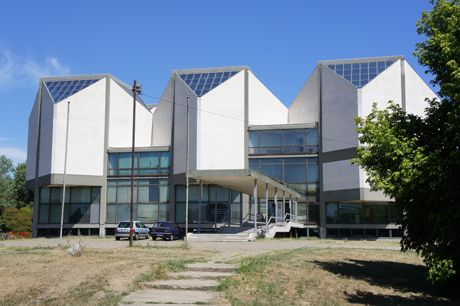
 This year’s October Salon, named GOOD LIFE / ГУД ЛАЈФ, under support from City of Belgrade, takes place in one of the most beautiful but also one of the most neglected monumental edifices in Belgrade – building of Belgrade Shareholders’ Association (former building of the Geodetic Institute). The history of this building, in a way, presents the history of 20th century Serbia.
This inspiring location will be used as a space of ad hoc transformation where the works will be “implanted” in its present condition and in its existing historical narrative and architectural design. Every exhibition, in terms of both its physical and discursive realities, is first and foremost a specific form of exchange within a specific framework and under specific social conditions.
This year’s October Salon, named GOOD LIFE / ГУД ЛАЈФ, under support from City of Belgrade, takes place in one of the most beautiful but also one of the most neglected monumental edifices in Belgrade – building of Belgrade Shareholders’ Association (former building of the Geodetic Institute). The history of this building, in a way, presents the history of 20th century Serbia.
This inspiring location will be used as a space of ad hoc transformation where the works will be “implanted” in its present condition and in its existing historical narrative and architectural design. Every exhibition, in terms of both its physical and discursive realities, is first and foremost a specific form of exchange within a specific framework and under specific social conditions.
 Curators of this year's October Salon, Branislav Dimitrijević and Mika Hannula, assembled forty participants from Finland, Germany, Sweden, Slovakia, Turkey, Bulgaria, Croatia, Estonia, Netherland, Great Britan and Serbia.
 Central interest of curators and artists collaborating in this exhibition, is the relationship between spatial and social imagination, the possibility of transforming a space into a place, and a reflective narration into an active physical presence. The architectural setting of the Geodetic Institute building, and the narratives making up its history, are the starting points for reflections on social visions, promises and delusions, typical primarily of the local “version” of the attempt at, gradual progress in and eventual standstill on the path of the social modernization.
The age of modernity was characterized by the capability of forging a vision of the future, which nowadays tends to be dismissed from the relativistic position of skepticism and irony. However, the basic promise of modernity, which essentially boils down to “a good life for everyone”, has remained an irreducible place of bringing together individual desires and social imagination in the process of continual circulation.
Exhibition Opening: Saturday, September 22, 1pm - former building of the Geodetic Institute Karađorđeva 48, Belgrade. The Salon will be open until November 4, 2012.
Central interest of curators and artists collaborating in this exhibition, is the relationship between spatial and social imagination, the possibility of transforming a space into a place, and a reflective narration into an active physical presence. The architectural setting of the Geodetic Institute building, and the narratives making up its history, are the starting points for reflections on social visions, promises and delusions, typical primarily of the local “version” of the attempt at, gradual progress in and eventual standstill on the path of the social modernization.
The age of modernity was characterized by the capability of forging a vision of the future, which nowadays tends to be dismissed from the relativistic position of skepticism and irony. However, the basic promise of modernity, which essentially boils down to “a good life for everyone”, has remained an irreducible place of bringing together individual desires and social imagination in the process of continual circulation.
Exhibition Opening: Saturday, September 22, 1pm - former building of the Geodetic Institute Karađorđeva 48, Belgrade. The Salon will be open until November 4, 2012.

 Last week the fourth International
  First day's topic were high-rises. It started with a lecture from Mark Hemel, co-owner of Dutch architecture studio
  Winka Dubbeldam presented the work of her New York based architecture studio
  During the presentation of glass facade systems for high rises by the American company
  This presentation served as an introduction into the panel discussion Vertical City in which Winka Dubbeldam, Mark Hemel, prof. Ružica Božović-Stamenović, Žaklina Gligorijević and Belgrade's city architect Dejan Vasović took part. This interesting discussion yielded several interesting facts and opinions. The city architect talked about Belgrade's so-far negative experiences with high rises, referencing the difficulties in maintenance of housing towers, and the lack of parking in office towers. Guests form abroad suggested a defined and clear vision of Belgrade's future development is needed before any urban restrictions can be made. Although it was concluded Belgrade has potential to, in the future, become the home of an iconic tower, the question of motivation for such a project was raised. Different European cities have dealt with the issue in different ways, and Belgrade's city government, planners and architects should first agree on the city's future image and vision, and then decide whether extreme high-rises are a part of that identity.
 One of the lectures from the second day of the Conference also belongs to the discourse of the Vertical City. Florentine architect David Fisher, for technical reasons, appeared on the second day and presented his concept of
  The second day we also heard to interesting lectures that both treat Architecture as a political tool. Estonian architect Veronica Valk presented her concept of Compact City she has been developing through 13 years of practice in Talin, as the co-owner of architecture studio
  The final lecture of this year's conference was from the Spanish architect

FACEBOOK
LINKEDIN
NEWSLETTER
CONTACT